Tuesday, January 06, 2015

Ordinary: How to Turn the World Upside Down - A Review

I was originally excited to read Ordinary: How to Turn the World Upside Down. The description, with statements like, "Ordinary is not a call to be more radical. If anything, it is a call to the contrary. The kingdom of God isn’t coming with light shows, and shock and awe, but with lowly acts of service" caught my interest.  When I read it, I was encouraged, inspired, angered, frustrated and disappointed.

Merida makes the argument, quite convincingly, that acts of service aren't optional for the believer.  As a response to, and work of, the Gospel, we believers should be engaged in a lifestyle of caring for the disenfranchised and those without a voice.  We should be serving those who cannot repay, not for the praise, but out of a grateful response to a God who has redeemed us.

While I feel Merida makes his point, I was left with two nagging feelings.  First, the book felt like a bit of an overreaction to the highly theological and theoretical parts of his own life (and the lack of practical demonstration).  Second, while trying to make the case for the breadth of opportunities to serve the poor, needy, orphaned and widowed, the book quickly became an argument to rally behind the cause of human trafficking - a worthy cause - but currently the "cause-du-jour," both within the church and in the secular culture.

From my study of history, much of the oppression that has happened throughout time has been the result of the lack of economic opportunities or economic mobility.  Merida's arguments largely ignore, with the exception of one passing example, the role godly business leaders can play by giving the disenfranchised economic opportunities.  Giving people the opportunity to earn a liveable wage from a fair employer can do more to transform a community than all of the handouts could hope to accomplish. A mere two or three paragraphs highlighting the role that the business community can play in community transformation would have made a big difference.

One area I completely disagree with Pastor Merida was in his section on hospitality.  No doubt, the New Testament doesn't make hospitality an option.  I actually agree with his assessment that congregations should elevate the Pauline requirement of pastors to practice hospitality.  Where I completely disagree was Merida's assertion that homes could function as retreats.  I left the chapter feeling that taking a respite from serving others was sinful; if Merida's assertion is correct, then Jesus' regular withdrawals from others should be viewed as sinful, and that would be a heretical view.

I appreciate the final chapter of the book, where Tony Merida argues the reasons why service should serve as a response of the working of the gospel in our lives.  The paragraph reads much like a pop-theology treatise, and I appreciate that.  I wish, however, this chapter be moved to either chapter 1 or 2, as this lays the foundation for his entire book.  Placing it right before the conclusion, while, stylistically, is an interesting place to wrap up the book, could mean that the response to the book comes before the understanding of the reasons why there should be a response.

Overall, I'd like to recommend this book, but I'm struggling to recommend it.  Maybe this could be part of a small-group/community-group discussion.  Maybe it could be a topic for a discipleship group.  I cannot, however, recommend it for a young/new believer, as I'm concerned it could breed a response without a solid understanding of the work of the gospel in the believer's walk. A community discussion, especially when led by a mature believer, could foster good discussion and a correct response to Merida's important assertion.  

Sunday, September 07, 2014

How Can I be Sure - A Review

Every believer experiences periods of doubt. John Stevens explores this topic with candor and tact in his book How can I be Sure? 

As with other books in this series, I really enjoyed this book.  I found it to be relevant and timely.

Stevens first defines doubt, and I appreciate how he defines levels of doubt.  Some doubt is natural, some is dangerous, and Stevens outlines the various levels to highlight how dangerous guilt can be.

One of the first issues he deals with is salvation. Defining what salvation is - and is not - Stevens can then disarm (or highlight) one of the biggest forms of doubt a believer may experience.

I especially appreciate the tenor and the tone by which Stevens writes.  He tactfully deals with forms and types of doubt, and he firmly challenges various forms of doubt.

The methods for dealing with doubt outlined in the book are especially helpful. Stevens shares various ideas for combatting this common attack.  Some of these forms of defense are individual; many of the methods are exercised in community.

As with other books in this series, I highly recommend this book for small group discussion.  This book, especially, is a great topic for group discussion, as fighting doubt is best done in community.

Note: I received a review copy of the book from the publisher.  I was required to provide an honest, not necessarily favorable, review, and the opinions expressed are mine.
    

Friday, August 29, 2014

How Will the World End - A Review

Many, many, many books have been written on the topic of the Apocalypse.  Some have been from a biblical standpoint.  Some have been from a dystopian perspective of the world.  Few handle the topic with the care and perspective of Jeramie Rinne in How Will the World End? And other Questions About the Last Things and the Second Coming of Christ.

First, if you're not interested in escatalogical (end times) topics, this book is for you. If you're deeply immersed in the topic, this book is for you.  And, if you're anywhere along that timeline, yes, this book is for you.  Rinne writes the book with the perspective that anyone may walk away from reading it understanding a bit of what is to come.

A few cautions.  First, this is not a scholarly work; it is written for laypeople.  This is a pastoral work.  If you're looking for something very meaty, this won't be it.  But you will walk away with a cursory understanding of various perspectives.

Second, if you're looking for someone to tell you the "right" theory, you'll be disappointed.  While I could guess at Rinne's personal views, he only tips his and one topic, and he expressly states it's the view he personally subscribes to at the moment.

Third, if you're passionate about your theories, Rinne will not call you out as wrong or validate your views.  He is really just trying to highlight the various views and bring understanding to all, regardless of their views.

This quick read is worthy of your attention. If your small group is looking for a resource to spur discussion, this (along with the other Questions Christians Ask works) would be a great place to start. 

Note: I received a review copy of the book from the publisher.  I was required to provide an honest, not necessarily favorable, review, and the opinions expressed are mine.

Friday, July 25, 2014

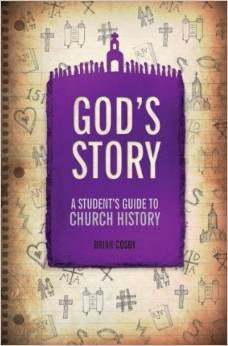
God's Story - A Review

Of the books I've reviewed over the past few months, this was one of the...most fun...to read.  While written specifically for 14 - to 17-year olds, I learned much through God's Story: A Student's Guide to Church History.


Brian Crosby's book is a brief walk (maybe a jog) through church history. He highlights various important people - some good, some not so good - throughout the history of the church.  He highlights these people as examples, some as examples to emulate, some as examples to help avoid the mistakes of the past.

One aspect to the book that I really appreciated was the way Crosby highlighted the sovereignty of God throughout.  He makes it abundantly apparent that God is absolutely in control.  Even when it appears He isn't present, God is orchestrating events.

A couple of cautions.  First, this is written for middle teens, aimed at 14- to 17-year olds. It would be a great discussion book for an 8th/9th grade small group.  For the more intellectually-inclined, you will find it slow, but you're not the target audience.

Second, keeping the audience in mind, the biographies are brief. I believe Crosby fairly handles the synapsis of each person's life, but, a discriminating eye may be led to critique the missing nuances in the biographies. Again, I'd remind the person of the target audience and the purpose of the book.

Overall, I really enjoyed this book, and I am recommending it to our pastor who oversees our church's teens group.  For the audience, the book is great.

A trailer to the book:


Note: I received a review copy of the book from the publisher.  I was required to provide an honest, not necessarily favorable, review, and the opinions expressed are mine.

Saturday, June 07, 2014

Active Spirituality - A Review

"At its heart, this collection is about the perseverance of the saints." - Brian Hedges, Active Spirituality.

Active Spirituality, by Brian Hedges, is a theological book packaged in a series of letters.  The letters are a pastor's comments to a friend, and he covers a wide range of spiritual topics.  The main thrust of the book is, while our salvation and sanctification are a gift of free grace from God, we have a responsibility to work hard to grow in this grace.

I liked the book. The format of the the letter-chapters was very interesting, and I found it to be very effective. He was able to communicate much in a personal, readable style.  Much of the book deals with living an active faith.

I found Hedges very effective at navigating a narrow path.  He effectively demonstrates the risk of two ditches on either side of the path.  One one side is an extreme works-based faith, which leads to a self-righteous legalism.  On the other side is an extreme grace-based faith, which, left unchecked, allows people to "punch their heaven ticket" and live an unchanged life.  Hedges does not deny the work of grace in the believer's life, but he reminds that discipleship and growth are necessary evidences of the faith.

I do have a couple of concerns with the book.  First - and this isn't limited to Hedges, but it tends to be pervasive in the modern Reformed movement - I wish he'd not address depression.  Too often, in Reformed circles, this topic is overly simplified, and I find the answers to be too flippant.

Second, I'm a bit bothered by the C.S. Lewis references. I'm a bit surprised, at times, how often Lewis' theological views are quoted, and he is drawn from often in this book.  Given some of Lewis' other issues, I'd rather not see him referenced in this context, as I think he could detract from this book.

Critiques aside, I found the book to be helpful, and I enjoyed it.

One head's up.  Hedges refers to John Bunyan's classic, A Pilgrim's Progress, often.  If you've never read it, get a copy now.  If you have read it, be prepared to read it again.  The many references made me want to dust my copy off and reread again.

Finally, here's an interview Shaun Tabatt conducted with Hedges. http://BibleGeekGoneWild.com/100.

Thank you, Brian Hedges, for your unique way of communicating deep, theological topics.  I benefitted from this book.

Note: I received a review copy of the book from the publisher.  I was required to provide an honest, not necessarily favorable, review, and the opinions expressed are mine.