Friday, August 29, 2014

How Will the World End - A Review

Many, many, many books have been written on the topic of the Apocalypse.  Some have been from a biblical standpoint.  Some have been from a dystopian perspective of the world.  Few handle the topic with the care and perspective of Jeramie Rinne in How Will the World End? And other Questions About the Last Things and the Second Coming of Christ.

First, if you're not interested in escatalogical (end times) topics, this book is for you. If you're deeply immersed in the topic, this book is for you.  And, if you're anywhere along that timeline, yes, this book is for you.  Rinne writes the book with the perspective that anyone may walk away from reading it understanding a bit of what is to come.

A few cautions.  First, this is not a scholarly work; it is written for laypeople.  This is a pastoral work.  If you're looking for something very meaty, this won't be it.  But you will walk away with a cursory understanding of various perspectives.

Second, if you're looking for someone to tell you the "right" theory, you'll be disappointed.  While I could guess at Rinne's personal views, he only tips his and one topic, and he expressly states it's the view he personally subscribes to at the moment.

Third, if you're passionate about your theories, Rinne will not call you out as wrong or validate your views.  He is really just trying to highlight the various views and bring understanding to all, regardless of their views.

This quick read is worthy of your attention. If your small group is looking for a resource to spur discussion, this (along with the other Questions Christians Ask works) would be a great place to start. 

Note: I received a review copy of the book from the publisher.  I was required to provide an honest, not necessarily favorable, review, and the opinions expressed are mine.

Friday, July 25, 2014

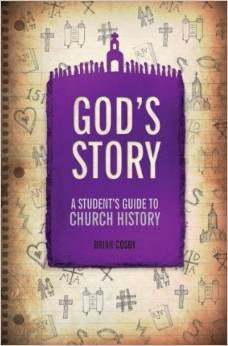
God's Story - A Review

Of the books I've reviewed over the past few months, this was one of the...most fun...to read.  While written specifically for 14 - to 17-year olds, I learned much through God's Story: A Student's Guide to Church History.


Brian Crosby's book is a brief walk (maybe a jog) through church history. He highlights various important people - some good, some not so good - throughout the history of the church.  He highlights these people as examples, some as examples to emulate, some as examples to help avoid the mistakes of the past.

One aspect to the book that I really appreciated was the way Crosby highlighted the sovereignty of God throughout.  He makes it abundantly apparent that God is absolutely in control.  Even when it appears He isn't present, God is orchestrating events.

A couple of cautions.  First, this is written for middle teens, aimed at 14- to 17-year olds. It would be a great discussion book for an 8th/9th grade small group.  For the more intellectually-inclined, you will find it slow, but you're not the target audience.

Second, keeping the audience in mind, the biographies are brief. I believe Crosby fairly handles the synapsis of each person's life, but, a discriminating eye may be led to critique the missing nuances in the biographies. Again, I'd remind the person of the target audience and the purpose of the book.

Overall, I really enjoyed this book, and I am recommending it to our pastor who oversees our church's teens group.  For the audience, the book is great.

A trailer to the book:


Note: I received a review copy of the book from the publisher.  I was required to provide an honest, not necessarily favorable, review, and the opinions expressed are mine.

Saturday, June 07, 2014

Active Spirituality - A Review

"At its heart, this collection is about the perseverance of the saints." - Brian Hedges, Active Spirituality.

Active Spirituality, by Brian Hedges, is a theological book packaged in a series of letters.  The letters are a pastor's comments to a friend, and he covers a wide range of spiritual topics.  The main thrust of the book is, while our salvation and sanctification are a gift of free grace from God, we have a responsibility to work hard to grow in this grace.

I liked the book. The format of the the letter-chapters was very interesting, and I found it to be very effective. He was able to communicate much in a personal, readable style.  Much of the book deals with living an active faith.

I found Hedges very effective at navigating a narrow path.  He effectively demonstrates the risk of two ditches on either side of the path.  One one side is an extreme works-based faith, which leads to a self-righteous legalism.  On the other side is an extreme grace-based faith, which, left unchecked, allows people to "punch their heaven ticket" and live an unchanged life.  Hedges does not deny the work of grace in the believer's life, but he reminds that discipleship and growth are necessary evidences of the faith.

I do have a couple of concerns with the book.  First - and this isn't limited to Hedges, but it tends to be pervasive in the modern Reformed movement - I wish he'd not address depression.  Too often, in Reformed circles, this topic is overly simplified, and I find the answers to be too flippant.

Second, I'm a bit bothered by the C.S. Lewis references. I'm a bit surprised, at times, how often Lewis' theological views are quoted, and he is drawn from often in this book.  Given some of Lewis' other issues, I'd rather not see him referenced in this context, as I think he could detract from this book.

Critiques aside, I found the book to be helpful, and I enjoyed it.

One head's up.  Hedges refers to John Bunyan's classic, A Pilgrim's Progress, often.  If you've never read it, get a copy now.  If you have read it, be prepared to read it again.  The many references made me want to dust my copy off and reread again.

Finally, here's an interview Shaun Tabatt conducted with Hedges. http://BibleGeekGoneWild.com/100.

Thank you, Brian Hedges, for your unique way of communicating deep, theological topics.  I benefitted from this book.

Note: I received a review copy of the book from the publisher.  I was required to provide an honest, not necessarily favorable, review, and the opinions expressed are mine.

Tuesday, April 29, 2014

Bible Revival: Recommitting Ourselves to One Book - A Review

"If there is anything truly necessary for life and godliness, it is already recorded in the Word of God." - Bible Revival, Kenneth  Berding

I was excited to read Bible Revival:.  This a topic I believe truly needed in our day of pluralism and post-modern worldview of foundationless viewpoints.  Unfortunately, the tone set in the preface and first chapter changed my view.

Before I get into what I believe Berding got wrong, I'd like to start with what I feel he got right.  First, I think he points to the necessary need for systematic study of the scriptures for growth.  For example, in chapter 1, he makes the following statement:  "Someone who comes to know Christ later in life and devotes himself to reading and learning God's Word will quickly surpass the person who relies upon the passive "learning" that he thinks he acquired from hanging around the church when he was young."  Berding addresses the need to commit to studying the scriptures in order to grow in the faith.

Second, he reminds us that part of the reason for studying the scriptures and memorizing passages is for use in daily life.  He relays the following statement from a single mom in his church, "She told me, 'During those difficult years, I always had a verse somewhere in my mind to fall back on. When my water heater broke, I was reminded that God cared for me in my need because I knew it from His Word.'"

Third, he does give practical examples and techniques for study.  For example, he draws some practical questions to ask when approaching a passage, he uses examples from Puritan life to study, and he encourages interaction with other believers.

That said, I had some very strong challenges to his book.  My biggest challenge is he almost advocates for a view of the Scriptures that, in some ways, ignores the GOD of the scriptures. He, for all practical purposes, ignores the requirement of the Holy Spirit to illuminate the Scriptures, and he assumes the Bible, in and of itself, is all that is needed (contrast this to Jesus' words in John 5).

Second, he speaks as an academic whose life is studying the Scriptures.  Since he has devoted his life to studying the Scriptures, all should give the same level of commitment.  This isn't practical.  Yes, we all need to study the Word for ourselves - and we need to be deliberate about it - but his level of commitment isn't practical. A troubling quote came from chapter 1, addressing single mothers who have spent many, many hours caring and providing for her children, "does she sleep at all at night? Then let her cut into some of that sleep and read her Bible." These are impractical, guilt-laden words.  I'm sure she has time to study the scriptures, but this isn't the way to go about it.

Third, the following quote from the preface negated everything that follows, "My paternal grandfather, who never came into personal relationship with Jesus Christ, read his Bible regularly and had many passages committed to memory." This tragic, misplaced statement negates his entire argument before it begins.

I'm giving this book 2 stars, but I am only giving it this rating because I appreciate what he's trying to do.  At the end of the day, my advice is this: skip this book and find a church that values, teaches, lives, and is shaped the Scriptures in a gospel community.

Note: I received a review copy of the book from the publisher.  I was required to provide an honest, not necessarily favorable, review, and the opinions expressed are mine.

Friday, April 11, 2014

Guiltless Living - A Review

"It's not that we focus on sinning so much as it is that we focus on the glory and grace of God." - Guiltless Living, Ginger Hubbard

Guiltless Living is an honest, realistic, hopeful narrative dealing with the aspect of remaining sin in our lives.  The answer, however, isn't necessarily what one might expect, based on the title.

This book isn't normally one I'd choose to read.  First, it's written by a women; I tend to read books written by men for men.  Second - and, yes, I know we're not supposed to judge by this - but the cover image is a woman, from the waste down, standing barefoot on a beach...in a polka-dotted dress; it looks more like a "chick lit" book than one with some deep spiritual truths.

I'm glad I ignored all of my preconceived ideas. I found some great nuggets of truth hidden behind the cover. While written from a woman's perspective, there is much that anyone reader - male or female, teen or adult, single or married - can glean from these pages.

I like that Hubbard shares personal stores, some her own and some of people close to her, to illustrate her point. By sharing these stories (some rather recent) disarms the reader by not feeling this is written by someone "who's arrived" but rather a fellow beggar sharing where to find bread.

Some topics covered are a critical spirit, pride, selfishness, control (as in controlling others), hoarding/miserly behavior, being self-focused, and religiosity. In light of what some of us view as "big sins," we may breeze past these topics, but Mrs. Hubbard highlights why these are particularly troubling sins, as most have idolatry at the core.

The pattern of the book is to reveal the sin - both in terms of a theological definition and practical examples.  Hubbard effectively reveals what these traits look like in the paces of life - aggressive driving, manipulative behaviors toward our children or spouses, our treatment of the server at the restaurant, etc.

I like that, while diagnosing the problem as sin, Hubbard's solution is the cross.  To "work harder" or "try more" would merely devolve into moralism.

One quote that sums up the book:

"All that we need to overcome sin has been provided to you.  The cure for sin is the cross.  Only through the power of Christ can sin's call be resisted.  When we set our attention on the power of the sacrificial atoning work of Christ, our hearts become filled with his love for us and our love for him.  Sin is crucified.  It weakens, becomes unattractive, and eventually loses its pull. It's not that we focus on not sinning so much as it is that we focus on the glory and grace of God.  As our hearts become more filled with God, there is less and less room for sin."

One point of caution to the guys reading this: if you're like me, since the book is written from a woman's perspective, you may be tempted to say, "Aha! I get it! THAT'S what my wife is doing!"  Don't fall into the temptation of finding your wife's failings in the pages of this book. 

May we all view our lives through the finished work of the cross - living from that place of victory and residing in the grace found at foot of our Savior.  


Note: I received a review copy of the book from the publisher.  I was required to provide an honest, not necessarily favorable, review, and the opinions expressed are mine.