Tuesday, January 16, 2018

Unimaginable - A Fitting Title

“...once God is pushed out of the picture, moral absolutes are very much in doubt.” - Jeremiah Johnston


When I set out to review Unimaginable - What Our World Would be Like Without Christianity by Dr. Jeremiah Johnston, my concern was that I wouldn’t have time to fact-check Dr. Johnston’s claims. Upon completion of the book, it turns out this worry became a minor concern in light of some of my other apprehensions.  

Before I launch into my issues with the book, I’d like to highlight what I found enlightening.  Though not stated, the premise of the book turned into an argument about human dignity and inherent worth. Johnston contrasted Christianity to humanistic and pagan views of human dignity. He effectively layed out the destructive ends to which the former views arrive if left unchecked - the devaluing and systematic destruction of individuals.

Johnston quoted original documents and this proved very effective.  The story at the beginning of chapter one - the letter from Hilarion to his pregnant wife, Alis, was both gripping and jarring. Likewise, the quotes and ideas from Sam Harris, Nietzsche, Huxley, Russell and Kinsey helped to add color to the narrative.

That said, I have four major concerns with this book. I will first state what my concerns are, then I will attempt to explain my concerns, and, finally, I will lay out what I think could help resolve my concerns.

First, I felt the thesis, or at least the foundation of the thesis, was incorrect, and it left much room for objections to the argument.  Second, the title and subtitle seem to oversell the actual text. Third, Johnston never dealt with a large time period which was highly damaging to the witness of the followers of Christ.  Finally, I found the flow of the text to be confusing, and I couldn’t track with the narrative until I was well into the middle third of the book.

Concerns
The Thesis
As I stated, I felt the thesis of the book - that humanity is protected by Christianity’s views of the world - didn’t get to the center of the concern.  It doesn’t materially change the defense of the argument, but the book neglects Common Grace and Original Sin (or Total Depravity), two topics that are nearly universally accepted within Christian circles. The issue of how people treat people is less rooted in the Christian moralistic argument and more rooted in the base nature of mankind. That is why practicers of other religions, non-religious people and atheists can and do good works for fellow humans. Neglecting to state the nature of humankind leaves the entire argument open to arguing the exceptions in all worldviews.

The Scope
The stated scope of this book was far too broad.  The subtitle indicates that the book deals with many manners of society...and it will do this in 200 pages.  To deal with treatment of people, societal structures, economic systems, governmental constructs, legal views - in a short book - is, at best, ambitious, and, more likely, nearly impossible even for the most skilled of writers.  

The book itself primarily focuses on the unique views of the value of humanity contrasting to pagan, humanistic and Darwinian views, and the book does a compelling job of arguing why Christianity is unique in this.  His drawing from Ancient Rome and the 20th Century brutal regimes is highly effective.  In this one topic, by itself, the book is very compelling.

Objectionable History
Johnston’s book skips from Ancient Rome to the humanistic philosophers of the Enlightenment.  There is good reason for this, as many modern philosophers drew inspiration from Rome’s Golden Age.  

The challenge is the book skips the very dark time of the Middle Ages. Often, Christianity’s strongest critics will point to this period as evidence of the failures of Christianity. It’s hard to disagree, especially as scientific exploration and mathematics flourished in the Muslim world, and Christianity grew more and more brutal.

I wish Johnston had devoted one chapter to this period.  It could be a short chapter that explained the differences between the strains of true Christianity that existed in spite of a very pagan culture with a veneer of Christianity placed on it.  Even a quick survey of the Dark Ages quickly reveals that the dominant strains of what was called Christianity had no foundations in the Scriptures, and a short chapter stating this could have prevented the argument from being left open.  

The Narrative
The book never clearly states up front where it is going with the argument.  Maybe I’m just a lazy modern reader, but I like to be told what I’m going to be told, to be told, and then to be told what I was told.

I was completely lost in why the book started in Ancient Rome.  I understood a need for showing the brutality and inhumanity of the period, but Johnston doesn’t really get around to starting to make the connections until much later.  It left me feeling like an unanchored reader.

I would have preferred the author, at the close of his opening chapter, state his thesis and roadmap. As a reader, I didn’t need anything elaborate, but I would have preferred a hint as to where he was going with the book.

Recommendations
I think few small changes would greatly improve this book.  First, I would recommend a section that deals with Original Sin. This section can be short, maybe part of the introductory chapter, but I think it’s necessary to understand the origins of worldviews and why the Christian worldview is unique.

Second, I’d add a quick roadmap in the first chapter explaining how the book is structured and where’s he is headed.  This gives some context.

Third, I feel the the subtitle is too ambitious. I think it oversells the work.  I like that the book focuses on the treatment of humanity, especially the vulnerable and marginalized, but the subtitle makes it sound more ambitious and broad than the book really is.  Focusing on the value of humans - image bearers of God - is a big topic in and of itself.

Finally, I would strongly recommend a chapter to deal with objections and damaging history. Don’t shy away from the medieval Catholic Church; run to confront the anti-biblical views.  Don’t ignore how the Lutheran and Catholic Churches were complicit in Nazi Germany; explain how they were wrong. If the premise of the book is built on Original Sin and Common Grace, the dark moments in the faith’s history become part of the redemptive stories of the faith.

In conclusion, I wouldn’t recommend the book, though some big names (Thom Rainer, Lee Strobel, Sheila Walsh, and Sean McDowell, to name a few), have endorsed it. I think there is value in exploring the contrasting worldview implications of the inherent value of humanity - and with the changes I recommend - this book could move from my “Don’t Read” to “Read” list.

Note: I received a review copy of the book from the publisher.  I was required to provide an honest, not necessarily favorable, review, and the opinions expressed are mine.

Tuesday, January 06, 2015

Ordinary: How to Turn the World Upside Down - A Review

I was originally excited to read Ordinary: How to Turn the World Upside Down. The description, with statements like, "Ordinary is not a call to be more radical. If anything, it is a call to the contrary. The kingdom of God isn’t coming with light shows, and shock and awe, but with lowly acts of service" caught my interest.  When I read it, I was encouraged, inspired, angered, frustrated and disappointed.

Merida makes the argument, quite convincingly, that acts of service aren't optional for the believer.  As a response to, and work of, the Gospel, we believers should be engaged in a lifestyle of caring for the disenfranchised and those without a voice.  We should be serving those who cannot repay, not for the praise, but out of a grateful response to a God who has redeemed us.

While I feel Merida makes his point, I was left with two nagging feelings.  First, the book felt like a bit of an overreaction to the highly theological and theoretical parts of his own life (and the lack of practical demonstration).  Second, while trying to make the case for the breadth of opportunities to serve the poor, needy, orphaned and widowed, the book quickly became an argument to rally behind the cause of human trafficking - a worthy cause - but currently the "cause-du-jour," both within the church and in the secular culture.

From my study of history, much of the oppression that has happened throughout time has been the result of the lack of economic opportunities or economic mobility.  Merida's arguments largely ignore, with the exception of one passing example, the role godly business leaders can play by giving the disenfranchised economic opportunities.  Giving people the opportunity to earn a liveable wage from a fair employer can do more to transform a community than all of the handouts could hope to accomplish. A mere two or three paragraphs highlighting the role that the business community can play in community transformation would have made a big difference.

One area I completely disagree with Pastor Merida was in his section on hospitality.  No doubt, the New Testament doesn't make hospitality an option.  I actually agree with his assessment that congregations should elevate the Pauline requirement of pastors to practice hospitality.  Where I completely disagree was Merida's assertion that homes could function as retreats.  I left the chapter feeling that taking a respite from serving others was sinful; if Merida's assertion is correct, then Jesus' regular withdrawals from others should be viewed as sinful, and that would be a heretical view.

I appreciate the final chapter of the book, where Tony Merida argues the reasons why service should serve as a response of the working of the gospel in our lives.  The paragraph reads much like a pop-theology treatise, and I appreciate that.  I wish, however, this chapter be moved to either chapter 1 or 2, as this lays the foundation for his entire book.  Placing it right before the conclusion, while, stylistically, is an interesting place to wrap up the book, could mean that the response to the book comes before the understanding of the reasons why there should be a response.

Overall, I'd like to recommend this book, but I'm struggling to recommend it.  Maybe this could be part of a small-group/community-group discussion.  Maybe it could be a topic for a discipleship group.  I cannot, however, recommend it for a young/new believer, as I'm concerned it could breed a response without a solid understanding of the work of the gospel in the believer's walk. A community discussion, especially when led by a mature believer, could foster good discussion and a correct response to Merida's important assertion.  

Sunday, September 07, 2014

How Can I be Sure - A Review

Every believer experiences periods of doubt. John Stevens explores this topic with candor and tact in his book How can I be Sure? 

As with other books in this series, I really enjoyed this book.  I found it to be relevant and timely.

Stevens first defines doubt, and I appreciate how he defines levels of doubt.  Some doubt is natural, some is dangerous, and Stevens outlines the various levels to highlight how dangerous guilt can be.

One of the first issues he deals with is salvation. Defining what salvation is - and is not - Stevens can then disarm (or highlight) one of the biggest forms of doubt a believer may experience.

I especially appreciate the tenor and the tone by which Stevens writes.  He tactfully deals with forms and types of doubt, and he firmly challenges various forms of doubt.

The methods for dealing with doubt outlined in the book are especially helpful. Stevens shares various ideas for combatting this common attack.  Some of these forms of defense are individual; many of the methods are exercised in community.

As with other books in this series, I highly recommend this book for small group discussion.  This book, especially, is a great topic for group discussion, as fighting doubt is best done in community.

Note: I received a review copy of the book from the publisher.  I was required to provide an honest, not necessarily favorable, review, and the opinions expressed are mine.
    

Friday, August 29, 2014

How Will the World End - A Review

Many, many, many books have been written on the topic of the Apocalypse.  Some have been from a biblical standpoint.  Some have been from a dystopian perspective of the world.  Few handle the topic with the care and perspective of Jeramie Rinne in How Will the World End? And other Questions About the Last Things and the Second Coming of Christ.

First, if you're not interested in escatalogical (end times) topics, this book is for you. If you're deeply immersed in the topic, this book is for you.  And, if you're anywhere along that timeline, yes, this book is for you.  Rinne writes the book with the perspective that anyone may walk away from reading it understanding a bit of what is to come.

A few cautions.  First, this is not a scholarly work; it is written for laypeople.  This is a pastoral work.  If you're looking for something very meaty, this won't be it.  But you will walk away with a cursory understanding of various perspectives.

Second, if you're looking for someone to tell you the "right" theory, you'll be disappointed.  While I could guess at Rinne's personal views, he only tips his and one topic, and he expressly states it's the view he personally subscribes to at the moment.

Third, if you're passionate about your theories, Rinne will not call you out as wrong or validate your views.  He is really just trying to highlight the various views and bring understanding to all, regardless of their views.

This quick read is worthy of your attention. If your small group is looking for a resource to spur discussion, this (along with the other Questions Christians Ask works) would be a great place to start. 

Note: I received a review copy of the book from the publisher.  I was required to provide an honest, not necessarily favorable, review, and the opinions expressed are mine.

Friday, July 25, 2014

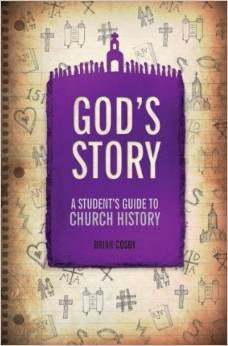
God's Story - A Review

Of the books I've reviewed over the past few months, this was one of the...most fun...to read.  While written specifically for 14 - to 17-year olds, I learned much through God's Story: A Student's Guide to Church History.


Brian Crosby's book is a brief walk (maybe a jog) through church history. He highlights various important people - some good, some not so good - throughout the history of the church.  He highlights these people as examples, some as examples to emulate, some as examples to help avoid the mistakes of the past.

One aspect to the book that I really appreciated was the way Crosby highlighted the sovereignty of God throughout.  He makes it abundantly apparent that God is absolutely in control.  Even when it appears He isn't present, God is orchestrating events.

A couple of cautions.  First, this is written for middle teens, aimed at 14- to 17-year olds. It would be a great discussion book for an 8th/9th grade small group.  For the more intellectually-inclined, you will find it slow, but you're not the target audience.

Second, keeping the audience in mind, the biographies are brief. I believe Crosby fairly handles the synapsis of each person's life, but, a discriminating eye may be led to critique the missing nuances in the biographies. Again, I'd remind the person of the target audience and the purpose of the book.

Overall, I really enjoyed this book, and I am recommending it to our pastor who oversees our church's teens group.  For the audience, the book is great.

A trailer to the book:


Note: I received a review copy of the book from the publisher.  I was required to provide an honest, not necessarily favorable, review, and the opinions expressed are mine.
Saturday, June 07, 2014

Active Spirituality - A Review

"At its heart, this collection is about the perseverance of the saints." - Brian Hedges, Active Spirituality.

Active Spirituality, by Brian Hedges, is a theological book packaged in a series of letters.  The letters are a pastor's comments to a friend, and he covers a wide range of spiritual topics.  The main thrust of the book is, while our salvation and sanctification are a gift of free grace from God, we have a responsibility to work hard to grow in this grace.

I liked the book. The format of the the letter-chapters was very interesting, and I found it to be very effective. He was able to communicate much in a personal, readable style.  Much of the book deals with living an active faith.

I found Hedges very effective at navigating a narrow path.  He effectively demonstrates the risk of two ditches on either side of the path.  One one side is an extreme works-based faith, which leads to a self-righteous legalism.  On the other side is an extreme grace-based faith, which, left unchecked, allows people to "punch their heaven ticket" and live an unchanged life.  Hedges does not deny the work of grace in the believer's life, but he reminds that discipleship and growth are necessary evidences of the faith.

I do have a couple of concerns with the book.  First - and this isn't limited to Hedges, but it tends to be pervasive in the modern Reformed movement - I wish he'd not address depression.  Too often, in Reformed circles, this topic is overly simplified, and I find the answers to be too flippant.

Second, I'm a bit bothered by the C.S. Lewis references. I'm a bit surprised, at times, how often Lewis' theological views are quoted, and he is drawn from often in this book.  Given some of Lewis' other issues, I'd rather not see him referenced in this context, as I think he could detract from this book.

Critiques aside, I found the book to be helpful, and I enjoyed it.

One head's up.  Hedges refers to John Bunyan's classic, A Pilgrim's Progress, often.  If you've never read it, get a copy now.  If you have read it, be prepared to read it again.  The many references made me want to dust my copy off and reread again.

Finally, here's an interview Shaun Tabatt conducted with Hedges. http://BibleGeekGoneWild.com/100.

Thank you, Brian Hedges, for your unique way of communicating deep, theological topics.  I benefitted from this book.

Note: I received a review copy of the book from the publisher.  I was required to provide an honest, not necessarily favorable, review, and the opinions expressed are mine.

Tuesday, April 29, 2014

Bible Revival: Recommitting Ourselves to One Book - A Review

"If there is anything truly necessary for life and godliness, it is already recorded in the Word of God." - Bible Revival, Kenneth  Berding

I was excited to read Bible Revival:.  This a topic I believe truly needed in our day of pluralism and post-modern worldview of foundationless viewpoints.  Unfortunately, the tone set in the preface and first chapter changed my view.

Before I get into what I believe Berding got wrong, I'd like to start with what I feel he got right.  First, I think he points to the necessary need for systematic study of the scriptures for growth.  For example, in chapter 1, he makes the following statement:  "Someone who comes to know Christ later in life and devotes himself to reading and learning God's Word will quickly surpass the person who relies upon the passive "learning" that he thinks he acquired from hanging around the church when he was young."  Berding addresses the need to commit to studying the scriptures in order to grow in the faith.

Second, he reminds us that part of the reason for studying the scriptures and memorizing passages is for use in daily life.  He relays the following statement from a single mom in his church, "She told me, 'During those difficult years, I always had a verse somewhere in my mind to fall back on. When my water heater broke, I was reminded that God cared for me in my need because I knew it from His Word.'"

Third, he does give practical examples and techniques for study.  For example, he draws some practical questions to ask when approaching a passage, he uses examples from Puritan life to study, and he encourages interaction with other believers.

That said, I had some very strong challenges to his book.  My biggest challenge is he almost advocates for a view of the Scriptures that, in some ways, ignores the GOD of the scriptures. He, for all practical purposes, ignores the requirement of the Holy Spirit to illuminate the Scriptures, and he assumes the Bible, in and of itself, is all that is needed (contrast this to Jesus' words in John 5).

Second, he speaks as an academic whose life is studying the Scriptures.  Since he has devoted his life to studying the Scriptures, all should give the same level of commitment.  This isn't practical.  Yes, we all need to study the Word for ourselves - and we need to be deliberate about it - but his level of commitment isn't practical. A troubling quote came from chapter 1, addressing single mothers who have spent many, many hours caring and providing for her children, "does she sleep at all at night? Then let her cut into some of that sleep and read her Bible." These are impractical, guilt-laden words.  I'm sure she has time to study the scriptures, but this isn't the way to go about it.

Third, the following quote from the preface negated everything that follows, "My paternal grandfather, who never came into personal relationship with Jesus Christ, read his Bible regularly and had many passages committed to memory." This tragic, misplaced statement negates his entire argument before it begins.

I'm giving this book 2 stars, but I am only giving it this rating because I appreciate what he's trying to do.  At the end of the day, my advice is this: skip this book and find a church that values, teaches, lives, and is shaped the Scriptures in a gospel community.

Note: I received a review copy of the book from the publisher.  I was required to provide an honest, not necessarily favorable, review, and the opinions expressed are mine.

Friday, April 11, 2014

Guiltless Living - A Review

"It's not that we focus on sinning so much as it is that we focus on the glory and grace of God." - Guiltless Living, Ginger Hubbard

Guiltless Living is an honest, realistic, hopeful narrative dealing with the aspect of remaining sin in our lives.  The answer, however, isn't necessarily what one might expect, based on the title.

This book isn't normally one I'd choose to read.  First, it's written by a women; I tend to read books written by men for men.  Second - and, yes, I know we're not supposed to judge by this - but the cover image is a woman, from the waste down, standing barefoot on a beach...in a polka-dotted dress; it looks more like a "chick lit" book than one with some deep spiritual truths.

I'm glad I ignored all of my preconceived ideas. I found some great nuggets of truth hidden behind the cover. While written from a woman's perspective, there is much that anyone reader - male or female, teen or adult, single or married - can glean from these pages.

I like that Hubbard shares personal stores, some her own and some of people close to her, to illustrate her point. By sharing these stories (some rather recent) disarms the reader by not feeling this is written by someone "who's arrived" but rather a fellow beggar sharing where to find bread.

Some topics covered are a critical spirit, pride, selfishness, control (as in controlling others), hoarding/miserly behavior, being self-focused, and religiosity. In light of what some of us view as "big sins," we may breeze past these topics, but Mrs. Hubbard highlights why these are particularly troubling sins, as most have idolatry at the core.

The pattern of the book is to reveal the sin - both in terms of a theological definition and practical examples.  Hubbard effectively reveals what these traits look like in the paces of life - aggressive driving, manipulative behaviors toward our children or spouses, our treatment of the server at the restaurant, etc.

I like that, while diagnosing the problem as sin, Hubbard's solution is the cross.  To "work harder" or "try more" would merely devolve into moralism.

One quote that sums up the book:

"All that we need to overcome sin has been provided to you.  The cure for sin is the cross.  Only through the power of Christ can sin's call be resisted.  When we set our attention on the power of the sacrificial atoning work of Christ, our hearts become filled with his love for us and our love for him.  Sin is crucified.  It weakens, becomes unattractive, and eventually loses its pull. It's not that we focus on not sinning so much as it is that we focus on the glory and grace of God.  As our hearts become more filled with God, there is less and less room for sin."

One point of caution to the guys reading this: if you're like me, since the book is written from a woman's perspective, you may be tempted to say, "Aha! I get it! THAT'S what my wife is doing!"  Don't fall into the temptation of finding your wife's failings in the pages of this book. 

May we all view our lives through the finished work of the cross - living from that place of victory and residing in the grace found at foot of our Savior.  


Note: I received a review copy of the book from the publisher.  I was required to provide an honest, not necessarily favorable, review, and the opinions expressed are mine.

Friday, February 21, 2014

Spritual Warfare: A Biblical & Balanced Perspective - A Review

Many books on spiritual warfare either greatly emphasize Satan or completely ignore his operation in the life of believers.  Either ditch poses grave danger to the believer.  Brian Borgman and Rob Ventura navigate this thorny, yet very important, topic. 

I was a bit skeptical about this book, and I'm glad I gave it a shot.  This is one of the best books I've read in the past two years (ranking, for sure, in the top 3, and it contends for the top spot).  I've read others on the topic of spiritual warfare, much to my detriment. Some overly emphasize the role of the demonic.  Some emphasize the believer's walk.  In the forward, Steven Lawson states, "there are three formidable foes with which we contend - the world, the flesh and the devil."  Borgman and Ventura lay out a model for fighting, regardless of the front.

I was impressed with the expository approach they take to the topic.  The book is anchored on Ephesians 6:10-20, and they take one topic per chapter.  Each topic is explained, sometimes from several viewpoints, and then practical ways to employ the topic are expressed.

One unusual aspect to the book is notable: the enemy isn't given much print space.  He is not ignored, but, starting from the position that we fight from a place of victory in Christ, the adversary isn't given the press he gets in other books.

As I stated, Spiritual Warfare quickly rose to the top of the books I've read, both on this topic and others.  The principles expressed I'm employing immediately.  If you are in a spiritual battle (hint: if you're breathing and have a pulse, you are), I cannot commend this book to you enough. 

Thank you, Pastors Borgman and Ventura.  This book has been a true gift to me.


Note: I received a review copy of the book from the publisher.  I was required to provide an honest, not necessarily favorable, review, and the opinions expressed are mine.

Tuesday, February 04, 2014

Why I'm Unfriending Facebook (even for a time)

I'm unfriending Facebook. This may be for a time, and it may be for good.  That decision will come later.  For the time being, however, I'm leaving Facebook.  Why I'm leaving will take some explanation.

I don't know when it happened, but there was a decided shift in our culture. Somewhere along the line we confused disagreement with dislike, and we substituted debate for hatred.  In the wider culture, if someone disagreed, it was a sign the person didn't like the other person.  To engage in debate is now considered hatred, and, depending upon the topic, it's labeled as "hate speech" and can be a crime.

Facebook was different.  It was originally set up by college students for college students.  In the very early days (before I joined), it was a place for upcoming graduates to connect with employers.  It was a tool that was later replaced by LinkedIn (and others) as a method of networking.

It evolved from there to chronicle the lives of students (and maybe even record what the students couldn't remember).  This may not have been the healthiest of uses, and it was quickly replaced by likes of SnapChat and other, seedier, social media outlets.

Its further evolution took it into, what I term, a "Wild West college" phase; this was a time when Facebook was a place with few rules and lots of debate. Unlike the university system, honest debate happened. Sometimes it got ugly, but it was more open and honest.

As time went on, some of the culture's views on debate crept in.  I saw it from the faith community first. Disagreement on some theological issues was viewed as "unloving" or "divisive".  Disagreements were to be discounted; outright heresy was was to be ignored.  The only acceptable answers to anything theological was to praise the comment, regardless of its theological value.  Even a non-like on a re-post must be an indication of divisiveness.

Next, I saw this creep into social topics. It seemed the only topics and views allowed were those championed by the editorial board of the New York Times.  To disagree meant you must be one of a host of "-ophobe's".

My comments, and my responses to others' comments, have damaged relationships.  It's not that it was my goal, but it's the way of our society; to disagree with a comment apparently means I hate the person. My real-life relationships are more important to me than my online presence.

I'm unfriending Facebook, at least for a time.

Monday, November 11, 2013

Why Christ Came - A Review

"Our salvation does not depend on our performance but on Christ's." - Joel Beeke and William Boekestein, "Why Christ Came - 31 Meditations on the Incarnation"

I've read several books by Joel Beeke.  I've enjoyed all of them, but many are written with a college level in mind.  This book was different, but that doesn't mean it was a theological lightweight.

I was drawn to the concept.  Beeke and Boeestein explore 31 reasons Jesus came.  While timely for the advent season, this book is much deeper than the Baby in the Manger.  Much like John Piper's "Fifty Reasons Jesus Came to Die,"  this book explores topics outside of the normal meditations.

I really appreciate how scripture-soaked the book was.  Every topic is bathed in Bible passages.  This (1) adds credibility to the arguments, and (2) gives a starting point for further meditation. 

To give a little flavor of the Gospel-rich writings, I quote this from Chapter 26, "To Restore Human Nature to Holiness":

"Many people are quite satisfied with a religion of external rules and ceremonies because they have a superficial view of sin.  Perhaps they have fairly loose rules, such as a minimum requirement to attend public worship now and then. Or maybe they have stiff and complex rules consisting of behaviors almost as  intricate as a Japanese tea ceremony.  Either way, changes in behavior cannot purify the heart, for it is the seat of our corruption."


The authors continue to explain the Gospel in clear, concise terms.

This book would be great all year, although Advent or Lent would be great times to read.  The chapters are relatively short, which would make this a great devotional.  Fathers, if you're looking for a good family devotional for your older children (maybe 12+), this would be great; younger kids probably wouldn't grasp some of the ideas, but it's not inappropriate for that age group. 

I highly endorse this one.  Well done, Mr. Beeke and Mr. Boekestein.

Note: I received a review copy of the book from the publisher.  I was required to provide an honest, not necessarily favorable, review, and the opinions expressed are mine.

Friday, November 01, 2013

AsaSure

Now that ObamaCare is the law of the land, and now that the bill's been passed and we can now see what's in it, I've decided we need to propose something similar for auto insurance.  I hereby introduce AsaSure.

First of all, everyone will need to participate in AsaSure.  If anyone chooses to drive without insurance, it drives up the cost for everyone. If you don't drive, you'll still need AsaSure, in case you do. But don't worry, if you like your current insurance, you'll be able to keep your insurance, provided it meet some common-sense standards. 

Every policy will need to cover some basic, common-sense standards.  Body work, collision and routine maintenance will need to be covered.  So will window-tinting, filters, fluid changes and roadside assistance. Custom wheels and high-performance tire replacements will be covered under AsaSure.

Even though the very young drivers have traditionally cost more in claims, we cannot burden this very vulnerable age group.  Therefore we will switch to a community rating system, where everyone in a geographic area will pay the same, regardless of claim history.

Oh, and to protect drivers (and potential drivers) from those evil insurance companies, we'll preclude pre-existing incidents.  But don't worry; drivers are too honest to add AsaSurance after the accident.

Again, like I said at the outset, if you like your insurance, you can keep your insurance.  Unless, of course your policy is underinsurance (meaning you don't have roadside assistance or prepaid fuel); then, if your policy changes, even the premiums fluctuate a few cents, your policy will no longer be valid, and you'll have to purchase an AsaSure.

One final benefit of AsaSure.  We'll set up private exchanges for AsaSure-eligible companies to compete for your business.  Oh, sure, we'll collect ALL of your information in our secure (as we define secure) system and will know whether you purchase.  And we promise the exchange will be fully functional with no major outages.

AsaSure.  The better way to insure driving. 

Wednesday, October 16, 2013

The Looming Shutdown

Tomorrow could be an interesting day in my world of forecasting business trends.  This Government has done pretty much everything possible to screw up our feeble recovery.  From the Republicans' Obamacare fight (ignoring the larger spending problem - even ADDING to spending merely to repeal Obamacare) to the President's unwillingness to do any negotiation to Harry Reid's idea that negotiation is "give me everything I want, and we'll talk later."

This was wholly unnecessary.  The Republicans zeroed in on Obamacare at the expense of entitlement spending.  They successfully took focus off the President's signature legislation and turned onto themselves....all negative.  The better strategy would have been to force the bill to be implemented as written and focus on bigger spending problems we have; let Obamacare collapse in on itself and propose true free-market solutions to fix the entire mess.

The president has been no better. His list of negotiable items was so short, it could be written on a 1x1 post-it note.  He's claimed a willingness to compromise, but the amount he's been willing to move is so miniscule it's hardly detectible.

And then there's Harry Reid.  He's said he'll talk after the debt ceiling is raised and Sequester 2.0 (I still can't call an 83% open government "shut down") is ended.  This would be like offering to buy a car, getting the seller to sign over the title and handing over the keys, and then negotiating a price several months later.

And who's to blame?  We are.  You and me.  We cast our ballots, and we got what we voted for.  I've talked to several people at conferences lately, and they all say the same thing: elections have consequences.  I guess we have ours. 

Tuesday, October 15, 2013

The New Conservatives - It's Time

I've changed my mind about the Republican Party.  I used to think that the party needed to purge the Lindsay Grahams, Peter Kings, John McCains and Olympia Snowes.  No longer.

It's time for a true third party to rise. It's time for the Ted Cruz's, the Mike Lees, the Rand Pauls, the Rick Perrys, the Bobby Jindahls and the Nikki Haleys to rally under a new banner truly built on the principles of liberty and smaller government.  It's time to put our house of state in order, not attempt to manage the affairs of the world. It's time for the Marco Rubios and the Mitt Romneys choose their political allegiances.

Let the Republican and Democratic parties reunite under one party.  Let them fight among themselves about the rate of expansion within the government.  It's time for a new voice.  It's time for those who just want to be left alone to rally and be heard.  It's time to push back on being labeled simply to avoid debate.

It's time for a new party constructed by and for the people, not just for the special interests. It's time for a party focused on the First Principles of the Constitution.  It's time for a party unashamed to say no.  It's time for a party to foster personal responsibility and community care, not an excuse to allow an inefficient government to absorb the roles of local charities, school boards and town councils.

It's time.

Wednesday, October 02, 2013

The Emotional Issues with Gen X and Gen Y

I'm not a psychologist, and I feel that qualifies me to talk about emotional issues.  Hey, Oprah and Maury Povich do all the time, so why not me?  Before I get into the topic at hand, I should start by saying this: I should never eat lunch alone, especially when I'm taking cold & allergy medication; I think that may have been the cause of this post.

Now on to the topic at hand.  It dawned on me the source of the emotional problems in my generation.  While I grew up in an age with MTV, rampant violence in entertainment, broken homes, overly high - or overly low - expectations, academic pressure and rampant materialism, I don't think that's the problem. No, I blame The Oregon Trail and the Choose Your Own Adventure book series.

"Seriously, ReallyAsa?  Oregon Trail and Choose Your Own Adventure? These were great learning tools, getting kids interested in learning history and decision-making skills."  True, they did teach those things, but they taught a whole lot more.

Let's start with The Oregon Trail.  The player, some eight-year-old in Mrs. Padenska's Red reading group, finishes his assignments early and gets to play on the computer for 1/2 hour.  He chooses to be the doctor, since he starts with the most money, and names the travelers after Gramma, PopPop, and his baby sister.  During the course of the game, he hunts and trades...and watches the entire party die of a high fever, dysentery and starvation.  Wow.  Some eight-year-old killed his entire family, all because he earned computer time for finishing his vocabulary worksheet early.

Onto Choose Your Own Adventure. That same eight-year-old rushes home with his latest installment from his book series. Mystery, intrigue, treasure - what's not to like?  It's like the other stories he's read, but he gets to be the protagonist AND gets to dictate the story by the choices he makes. It's like an arcade game in printed form. He chooses his path through the house, he navigates his way....and BAM! "You died."  What?! He goes back and tries again - same result.  Wow.

This post is somewhat tongue-in-cheek, but there are some serious undertones.  While these tools taught problem-solving skills, the stakes portrayed were high and the decisions were left somewhat to chance.  There was little in the way of learning to weigh the options; it was more of a lottery approach.

Fast forward to high school, college, employment, marriage.  The lessons taught may have inadvertently paralyzed some from making decisions.  What if my college choice is a dud?  What if I choose the wrong career path?  What if someone better comes along?

We need to be cautious of the educational and entertainment choices we select in Choosing our Adventure of life.


Tuesday, October 01, 2013

The Debt Ceiling - My Doomsday Scenario

First, let me preface this by saying I doubt this will happen.  That said, it's a real possibility.

Today is the first day of the Federal Government shutdown.  Recent history - recent as in the past 5 years - has shown Congress is so entrenched that compromise is nearly impossible. And this is the precursor to the bigger showdown: the debt ceiling debate.

Maybe today's shutdown will delay our reaching the Congressionally-imposed debt ceiling by a few days, and maybe that will delay what I think could be a major crisis in this nation. When the debt ceiling is reached, however, stakes will be raised.

Here is what I see as the potential, however unlikely, scenario. Congress has the responsibility to authorize borrowing and spending per the Constitution (I could spell out the enumerated powers, but I'll let you read the Constitution; sections 7.1 and 8.2 are starters).  Provided Congress cannot agree upon a new spending limit, things start moving.

Some are arguing the President violate The Constitution, because, to ignore it, is to violate other aspects of his oath.  This is where things get interesting. At this point, I won't discuss what I see are the potential financial implications; I'll stick to the political.

Should the President ignore the debt and continue to borrow, the House will have no choice but to draw up Articles of Impeachment. The House will, most likely approve the charges, and the Senate will then be forced to try the case.  Given the Senate's loyalty to the President, I doubt they will convict.

Once the President is cleared of the charges, Texas, Oklahoma and, potentially, Arizona and the Carolinas, will withdraw their Congressional representation - leaving their Senators to continue to voice protest - and cast no-confidence votes in the Federal Government.  When this happens, they will withdraw all participation in Federal programs.  Other states will hold votes to determine their stance.

I doubt this will play out, but it's not out of the question.  What will happen?  We shall see.


Friday, September 27, 2013

Review - Apostate: The Men Who Destroyed the Christian West

I'm neither a philosophy major nor a theology major.  That said, I know how to reason and think logically through conclusions.  My personal conclusion of Apostate: The Men Who Destroyed the Christian West is that this book makes bold and dangerous conclusions.

This book could have been great, but, instead, Kevin Swanson ruins it with his own personal political and economic viewpoints. In many cases, I actually agree with his personal views, but I would never argue that my views are "biblical," as I could easily argue the opposite view from the Bible as effectively.

First, let me start with what I believe Kevin Swanson does well. Swanson's summaries of the various individuals he profiles is short, succinct and effectively summarizes each person's ideas. He can summarize the teachings in a very short space.

And that leads me to several challenges and issues I have with this book.  My strongest frustration is his misapplied alliances. Far too often he masks his democratic hyper-capitalistic through the cloak of the Bible. Repeatedly he argues that Matthew 20:1-15 is a defense of privately-negotiated labor contracts.  He also uses other passages out of context or a complete different conclusion from the accepted point - the very error he says individuals like Thomas Aquinas make.

Second, which is like the first, he argues often for a "Godly" form of government by arguing the Hebrew laws from Exodus - Deuteronomy....even those that were specifically applied to the Hebrew people, not just those which God commanded to multiple people. To make such an assertion is dangerous and a misuse of Scripture.

Third, Swanson repeatedly oversells his arguments. He could allow the philosopher's words convict; instead, he makes wild accusations, often without strong proof.  Rather than merely stating the viewpoint, and maybe add a small commentary, he greatly oversells his critique.  

To keep this short, I'll conclude with my personal frustration.  Early, he makes this statement, "If professing Christians disagree with me on this point,I wonder if they have joined the other side, or if perhaps they are too fearful to recognize the true magnitude of the social and cultural problems that confront the modern world."  This is a bully's technique, employed by other philosophers like Richard Dawkins; to disagree is to be unintelligent, or in his case, not a "good Christian."

Bottom line: I feel this book is very dangerous, but at least those who would be most swayed by his misused assertions won't likely be drawn to this book. His summaries of the philosophers could be helpful, but his personal commentaries are very dangerous. Take my advice: skip this book.


Note: I received a review copy of the book from the publisher.  I was required to provide an honest, not necessarily favorable, review, and the opinions expressed are mine.

Friday, September 20, 2013

God in My Everything - A Friendly Critique

"What if there was a way to experience God as your deep center, not only in your formal prayers and Bible reading, but in the midst of your studies, work, exercise and play?" - Ken Shigematsu, God in My Everything

I was intrigued by this book.  I knew nothing about Ken Shigematsu, Tenth Church, or the overall concept of his theory.  But, as spiritual beings, I was interested in his thoughts. Here is a trailer to the book: http://youtu.be/SgtA_hbrgyg.

The overall thought behind God in My Everything  is developing a "rule" for life.  He explains why, but he treats a rule like a trellis - a plan for living life.  The trellis for life is built on three main foundations and is both about personal care and interpersonal life.

Many of his examples and framework come from, of all places, medieval (and modern) monastic life.  To be honest, I was very skeptical of applying a "how to live" for people sequestered from society in a very different time from now.  I was pleasantly surprised.

Personally, I enjoyed the book.  I've learned much about the rhythms of life, how to enjoy God in every aspect of life and how to build a workable structure for life.  That said, I'm a bit hesitant to recommend the book.

First, and this is a critique I have of many evangelical books, it assumes the reader has an understanding of the Gospel.  That very well may be, but it's dangerous to assume the reader is starting from a classical Christian understanding.

And that leads to my other concern.  Because Shigematsu assumes a Christian understanding, the book could have a bit of a universalistic or pantheistic feel to it. I think that's because common grace is very real.  And because of this, the book could become a tool for promoting all sorts of cultist or non-christian views.

Overall, I found the book very enjoyable and beneficial.  I would shy away from using this book outside of a strong theological underpinning, but it would make a great discussion book for a discipleship book or church leadership discussion. 

Note: I received a review copy of the book from the publisher.  I was required to provide an honest, not necessarily favorable, review, and the opinions expressed are mine.

Wednesday, August 14, 2013

Review - Humble Orthodoy

"Shouldn't individuals and churches that hold most faithfully to orthodoxy and biblical truth be the most frequently filled with godly repentance?" - Josh Harris

Before I get into the bulk of my review, I am going to say this: get Humble Orthodoxy: Holding the Truth High Without Putting People Down.  Normally I don't endorse a book this strongly, but this one is very important.

Humble Orthodoxy was taken from Joshua Harris' Dug Down Deep.  Based on what I read in this book, I have added Dug Down Deep to my short list of "to-buy" books.

In some ways, I was a bit surprised at this book.  Harris navigates maybe one of the most challenging tensions in the Christian faith: how do we hold to both humility and truth?  He skillfully demonstrates the pitfalls in both camps - those that claim to hold to truth and those who claim grace.

Harris articulates that 1) truth (orthodoxy) matters, and 2) so does our approach.  To emphasize one over the other is a biblical error.  In many ways, he successfully offends both the "truth" and the "grace" crowds...and we need it, because, I believe, it's a Godly conviction.

Harris highlights throughout the book that this is an issue of the heart.  This is steeped in attitude.  For example, on page 5, he says, "We must care deeply about truth, and we must also defend and share this truth with compassion and humility."  This is a theme repeated throughout the book.  Truth matters, but so does the attitude in which it's delivered.

I think what I appreciated most was the humility with which Harris writes and also the conviction in the message he shares.  He never advocates for softening the message, but he implores sharing with a tenderness.  Much of what he shares is pointing back to our own conversion, remembering the gentleness in which Jesus welcomed us.

This may be one of the most crucial books for our generation.  Truth is being attacked from many sides, and there are two dangerous tendencies within the church.  First, some advocate for turning aside from the truth, embracing a more Universalist approach to the faith.  Second, others are determined to defend the truth, regardless of how the message is perceived.  The message Harris leaves with the reader is this: we should absolutely defend the truth, but we should do it with the humility of an individual who recognizes what they've been saved from.

I'll close with my favorite quote from the book.  On page 57, Harris writes, "In eternity we'll see the silliness of self-righteousness and quarreling over non essentials.  But we'll also see with piercing clarity just how essential the essentials really are." When speaking of revealing the very nature of God, sharing orthodoxy with humility is imperative.   

I received this book for free from WaterBrook Multnomah Publishing Group for this review.

Sunday, August 11, 2013

"Unveiling Grace" - A Review

Normally, with my reviews, I start out with a quote or an anecdote from the book.  This time, I'm taking a different approach.  I want to start with a confession.

As I read Lynn Wilder's Unveiling Grace - The Story of How We Found Our Way Out of the The Mormon Church, I wanted the story to be false.  I wanted to learn that what she was revealing was untrue about the Mormon faith.  Sadly, it's not.

Before I get into the topic of the story itself, let me comment on the style.  Wilder shares their story more like a narrative, and, within their story, she weaves in teachings from the Latter Day Saints (LDS).  The story has almost the feel of a clandestine spy novel.  Her storytelling style pulls the reader along, much like a well-written dramatic tale.  From a pure storytelling standpoint, I enjoyed it.

From the content, however, I was very disturbed.  It was not her story that disturbed me, however, but rather the content of her story.  To get a first-hand story of the LDS church, I was very much shocked and saddened at what she reveals. 

Unveiling Grace is not a story written by an embittered ex-member of the LDS.  Rather, this is the story of a couple steeped in the faith (he was very active in Temple activities, teaching, leading; she was a full professor at Brigham Young University) and their journey to the biblical Jesus.

Back to my first comment.  I really wanted this story to be false.  Why do I say that?  Even if Wilder exaggerated facts - even if only 10% of her story was true (I believe her story is as she tells it) - it saddens me to know so many people have been, and are continually being, wooed to a false gospel.

Wilder adds three appendices which I found to be of great use.  First, she lists a series of resources for Mormons seeking to know the truth about LDS teaching and for help in leaving the Mormon faith...and for non-Mormons to understand the truth about the LDS.  Second, she adds a rather large appendix that lists what the Doctrines & Covenants (an LDS book) teach compared to the Bible; this alone is probably worth the price of the book.  Third, she includes a glossary of Mormon terminology; reading the book, I referred to this often, even though she does a great job of defining terms within the text.

One small critique I have, overall, is sometimes it's a bit challenging, especially near the end of the book, to track with the timeline.  At times, I was a bit confused, as she starts interweaving story lines, and it would have been helpful to have dates more explicitly called out.  This is a small critique, and when this book goes for its second printing (as I hope it does), it would be nice to see that cleaned up a bit.

One final thought.  As a Christian, I found myself very convicted reading Wilder's story.  Too often we take our faith, and our interactions with others, far too lightly.  Wilder has encouraged me to engage people respectfully, but honestly, probing what they believe and why.  In some ways, I felt the same conviction I felt from David Platt's statement about a "functional universalism" in the church.

Did I agree with everything in the book?  No. There were some aspects of the Christian faith that I'm not sure I agreed with Wilder.  But my understanding of biblical Christianity and the view she espouses were congruent on the "big" topics, and my disagreements were more on the road of sanctification, not salvation.

Overall, I found this book to be very helpful.  Key audiences would be 1) Mormons - both practicing and non-practicing, 2) Christians, especially those with an active Mormon congregation in their area, and 3) those seeking out faith in general.

Disclosure of Material Connection: I received this book free from Thomas Nelson Publishers as part of their BookSneeze.com book review bloggers program. I was not required to write a positive review. The opinions I have expressed are my own. I am disclosing this in accordance with the Federal Trade Commission’s 16 CFR, Part 255 : “Guides Concerning the Use of Endorsements and Testimonials in Advertising.”